Antibody Structure — Domains, Isotypes, & Clinical Relevance
Antibodies (immunoglobulins) are Y-shaped glycoproteins made of two heavy and two light chains. Their Fab regions bind antigen via CDRs; Fc regions engage immune effectors (Fc receptors, complement). Structure underlies neutralization, opsonization, complement activation, and clinical uses of monoclonals.
🧬 Antibody Structure
Antibody Structure — Domains, Isotypes, & Clinical Relevance
Antibodies (immunoglobulins, Ig) are central to adaptive immunity. Their **structure** explains their **function**—from precise antigen recognition to effector activation. Here’s a deep dive into domains, isotypes, binding chemistry, and why architecture matters in diagnostics and therapeutics.
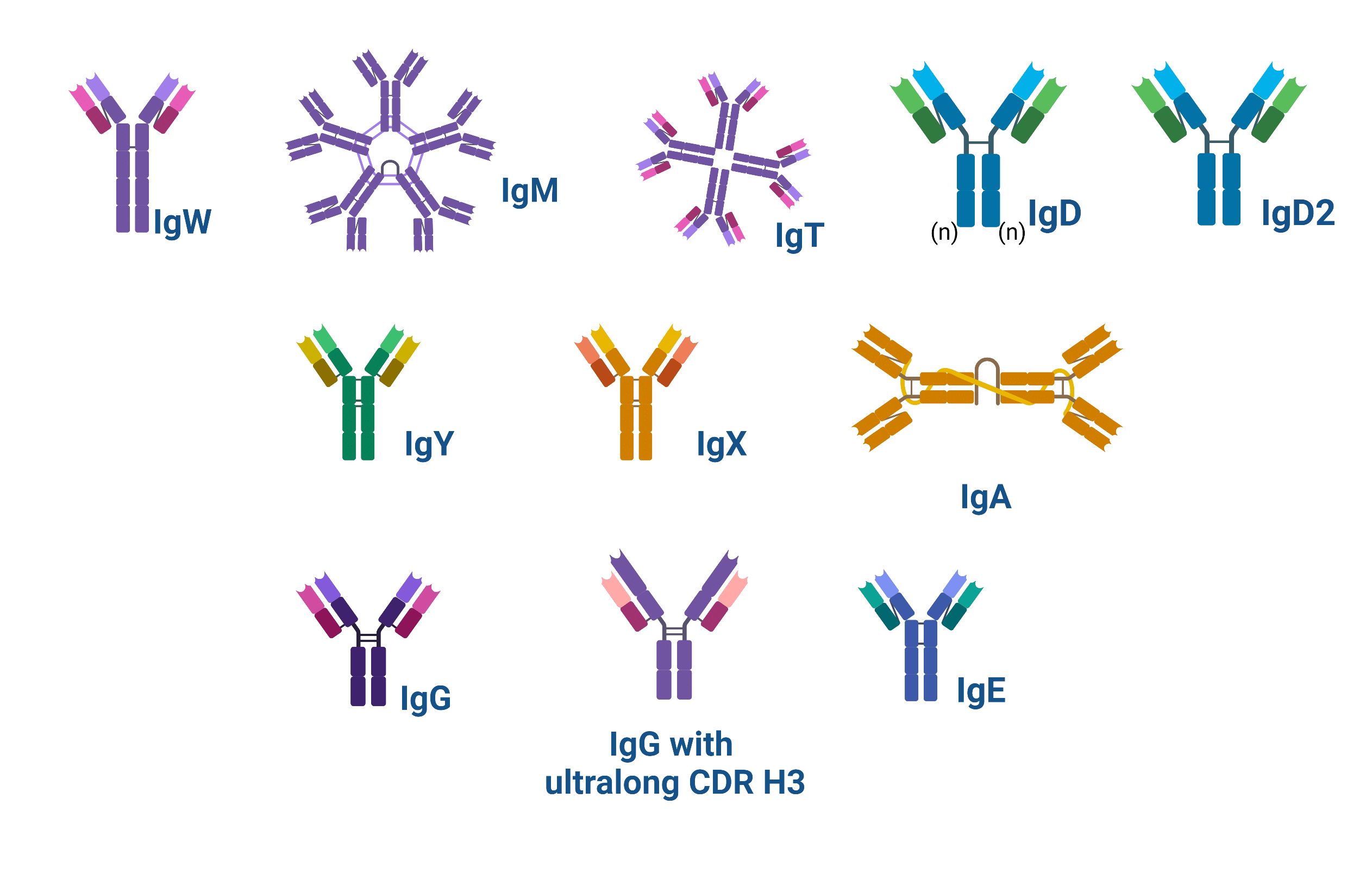
1) Overview & Core Functions
Key effector roles include neutralization (block toxins/viruses), opsonization (tag for phagocytes), complement activation (classical pathway), and agglutination (clumping to aid clearance). These roles depend on modular domains that couple **specific recognition** to **immune activation**.
2) Quaternary Architecture & Domains
2.1 Chains & Disulfides
- Two heavy (H) chains (~50 kDa each) + two light (L) chains (~25 kDa each).
- Inter- and intrachain disulfide bonds stabilize the Y-shaped heterotetramer.
- Each chain comprises repeating immunoglobulin folds (β-sandwich domains).
2.2 Fab vs Fc
- Fab (antigen-binding): Variable (V) + Constant (C) domains from H and L chains; contains CDR1–3 loops that form the paratope.
- Fc (crystallizable): Heavy-chain constant domains (e.g., CH2–CH3) that engage Fc receptors and complement.
- Hinge: Flexible linker between Fab and Fc, increasing angular reach and avidity; prominent in IgG/IgA.
2.3 Variable Regions, CDRs, and Specificity
- CDRs are hypervariable loops within VH and VL that determine specificity and affinity for an epitope (linear or conformational).
- Paratope–epitope binding uses noncovalent forces (H-bonds, electrostatic, van der Waals, hydrophobic).
- Affinity (single site) vs avidity (combined binding across sites; high in IgM pentamers and IgA dimers).
2.4 Glycosylation
- IgG Fc typically carries an N-linked glycan (classically near Asn297), modulating Fc receptor binding and complement engagement.
- Glycan composition can tune effector function (e.g., ADCC potency via FcγRIIIa interactions).
3) Isotypes & Subclasses
Heavy chain class (γ, α, μ, ε, δ) defines the five major isotypes; each has characteristic **Fc** structure and effector profile.
IgG (γ) — Monomer
- ~75–80% of serum Ig; versatile: neutralization, opsonization, complement.
- Placental transfer via FcRn provides neonatal passive immunity.
- Subclasses: IgG1–IgG4 (varying hinge length and effector strength).
IgA (α) — Dimer (secretory)
- Dominant at mucosae (tears, saliva, breast milk); forms secretory IgA with a J chain and secretory component.
- Subclasses: IgA1/IgA2 (hinge length differences influence protease sensitivity).
IgM (μ) — Pentamer
- First isotype produced; high avidity, potent in classical complement activation.
- Contains a J chain aiding polymerization and mucosal transport.
IgE (ε) — Monomer
- Binds high-affinity FcεRI on mast cells/basophils; allergy (histamine release) and anti-parasite roles.
IgD (δ) — Monomer
- Expressed with IgM on naive B cell surfaces; contributes to BCR signaling/activation.
4) Effector Coupling: Receptors & Complement
Fc Receptors (FcRs)
- FcγR (for IgG) on macrophages, NK cells: drive ADCP/ADCC; subclasses differ in affinity.
- FcαRI (for IgA) on myeloid cells: mucosal opsonophagocytosis.
- FcεRI (for IgE) on mast cells/basophils: degranulation upon cross-linking.
Neonatal Fc Receptor (FcRn)
- Transports IgG across placenta; in adults, recycles IgG to extend half-life (endosomal salvage).
Complement (Classical Pathway)
- IgG and IgM Fc regions bind C1q to initiate the cascade → opsonization (C3b), inflammation, lysis.
5) Antigen Binding Chemistry
- Noncovalent forces: hydrogen bonds, electrostatic interactions, van der Waals, hydrophobic contacts.
- Epitope types: linear (sequence) vs conformational (3D structure).
- Idiotype (unique variable-region determinants), allotype (allelic constant-region variants), isotype (class/subclass).
6) B Cell Expression & Diversification
BCR vs Secreted Ig
- Membrane BCR includes a tailpiece/transmembrane region for signaling (with Igα/Igβ).
- Plasma cells produce secreted antibodies lacking the transmembrane segment.
V(D)J, SHM, CSR (AID-dependent)
- V(D)J recombination builds primary repertoire (combinatorial & junctional diversity).
- Somatic hypermutation (SHM) + selection → affinity maturation.
- Class-switch recombination (CSR) changes isotype (μ/δ → γ/α/ε) without altering specificity.
7) Clinical & Biotech Applications
- Monoclonal antibodies (mAbs): oncology (e.g., anti-CD20, anti-HER2), autoimmune disease (e.g., anti-TNF), infectious disease neutralizers.
- Diagnostics: ELISA, Western blot, lateral-flow assays.
- Passive immunity: convalescent plasma; therapeutic neutralizing mAbs.
- Engineering: Fc glyco-/protein engineering to tune half-life, ADCC, and complement activity.