Nephrology
Kidney structure, function, and disease — from AKI to CKD and renal replacement therapy — with concise tables for fast reference.
1) Overview
Nephrology focuses on the kidneys — filtration, electrolyte balance, endocrine functions — and the prevention and treatment of acute and chronic kidney disease.
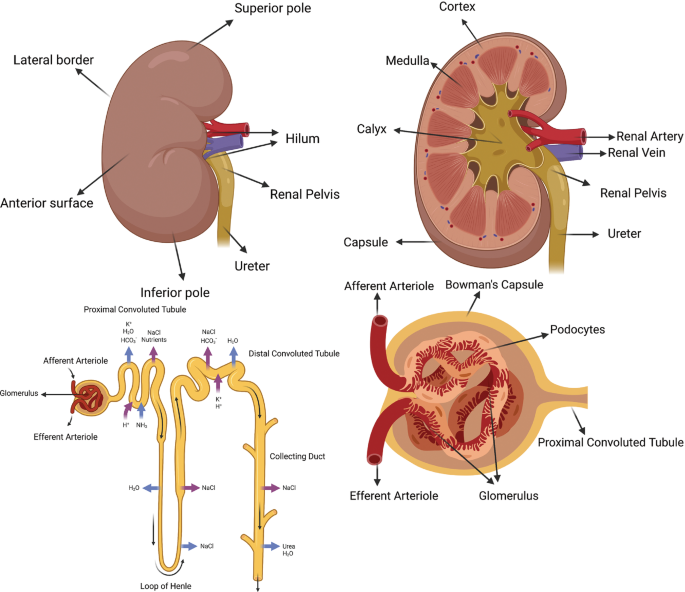
Kidney Anatomy & Physiology
- Location: Retroperitoneal, either side of the vertebral column.
- Size & Shape: Bean-shaped, ~10–12 cm long in adults.
- Cortex: Contains glomeruli.
- Medulla: Renal pyramids; loops of Henle and collecting ducts.
- Nephrons: ~1 million per kidney — functional filtration/reabsorption units.
- RAAS & EPO: Blood pressure regulation; red-cell production.
Nephron Structure & Function
| Segment | Primary Role |
|---|---|
| Glomerulus | Filters plasma → ultrafiltrate. |
| Proximal Tubule | Bulk reabsorption (water, Na⁺, glucose, amino acids, bicarbonate). |
| Loop of Henle | Countercurrent multiplier; concentrates/dilutes urine. |
| Distal Tubule | Fine-tuning of Na⁺/K⁺; acid–base balance. |
| Collecting Duct | ADH-mediated water reabsorption; final urine concentration. |
Kidney Functions
- Filtration of blood to remove metabolic waste
- Fluid and electrolyte regulation
- Acid–base homeostasis
- Blood pressure control via RAAS
- Erythropoiesis stimulation (EPO)
- Vitamin D activation (calcitriol)
2) Common Kidney Diseases
Acute Kidney Injury (AKI)
| Aspect | Details |
|---|---|
| Definition | Rapid decline in renal function over hours to days. |
| Causes | Pre-renal: hypovolemia, hypotension; Intrinsic: glomerulonephritis, acute tubular necrosis; Post-renal: obstruction. |
| Diagnosis | ↑ serum creatinine, ↓ urine output. |
| Management | Correct cause (fluids, relieve obstruction), avoid nephrotoxins, supportive care. |
Chronic Kidney Disease (CKD)
| Aspect | Details |
|---|---|
| Definition | Progressive loss of kidney function over months to years. |
| Stages | Based on eGFR (G1–G5) ± albuminuria (A1–A3). |
| Causes | Diabetes mellitus, hypertension, glomerulonephritis, polycystic kidney disease. |
| Complications | Anemia, CKD-MBD (bone/mineral), cardiovascular disease. |
| Management | BP control (ACEi/ARB), glycemic control, diet (Na⁺/K⁺/protein), prepare for dialysis or transplant in ESRD. |
Glomerular Diseases
| Examples | Presentation | Diagnosis | Treatment |
|---|---|---|---|
| Minimal change, FSGS, membranous | Proteinuria ± edema; nephrotic vs nephritic syndromes | Urinalysis, serology; kidney biopsy for definitive typing | Immunosuppression (disease-specific) + supportive care |
3) Diagnostic Approaches
| Category | Tests |
|---|---|
| Laboratory | Serum creatinine, BUN, eGFR; urinalysis (protein, blood, casts); electrolytes & acid–base; serologies (ANA, ANCA, complements). |
| Imaging | Ultrasound (size, obstruction, cysts); CT/MRI for stones, tumors, anatomy. |
4) Treatment Modalities
| Approach | Elements |
|---|---|
| Conservative | Control BP (ACEi/ARB), diabetes management, diet (protein/Na⁺/K⁺), correct anemia and bone disease. |
| Renal Replacement | Dialysis (hemodialysis, peritoneal); kidney transplantation (indications, immunosuppression, outcomes). |
5) Emerging Topics
- Precision medicine and genetic markers in nephropathies
- Advances in dialysis technology and home modalities
- Novel therapeutics for glomerulonephritis and diabetic nephropathy
- Telemedicine and remote monitoring in CKD care